

Refreshing a company website always sounds easier than it is. You know the feeling: stale pages, scattered messaging, missing content, and a homepage that no longer matches what your company is actually doing. I finally reached the point where Second Wave needed an update—something clearer, more authentic, and more aligned with how we build and ship products today.
Rather than starting from scratch, I tried an experiment: build the new site using the same AI-accelerated workflows we practice in our day-to-day engineering. The result? A full homepage refactor, supporting pages, and a clean deployment in about half a day.
Not because AI replaces the work, but because—when orchestrated well—it compresses the distance between ideas and execution.
Here's how it unfolded.
Gathering Requirements by Merging Memory, Content, and Intent
I began by consolidating everything I know about our business into a single source of truth. This meant pulling together existing site content, internal strategy docs, product positioning notes, and—critically—the running memory my AI assistant has built over months of conversation about Second Wave's direction.
That last part mattered more than I expected. Instead of starting cold, I had an assistant that already understood our tone, our market position, and the subtle distinctions we care about (practical intelligence vs. hype, for example). The synthesis wasn't just aggregation—it was contextualized.
From that, I produced a structured "website requirements" document: goals, tone, target audience, brand priorities, and page structure. This became the keystone for everything that followed. Every model I worked with downstream received this document as grounding context.
Gemini 3: From Requirements to First Draft Website
I fed the requirements into Gemini 3 through Google AI Studio. It returned a surprisingly cohesive first version of the site—pages, interactive components, navigation, and placeholder imagery.
The catch: Gemini created a static HTML/CSS/JS site with no file-based routing. Everything existed as one flat page. One of the interactive features relied on calling the Gemini API directly, which meant the API key needed to be server-side. Flat pages can't handle that safely.
So I had a functional but incomplete artifact—a sketch of a site, not a deployable Next.js app.

Moving to Next.js: Where Claude Code Took Over
I downloaded the Gemini output as a zip, dropped it into my project folder, and synced it manually into GitHub. Once it was in version control, I asked Claude Code to refactor the entire thing into a Next.js app:
- Proper file-based routing
- Server-side API wrappers for Gemini calls
- Integration with our existing component styles
- Normalization of layouts across pages
Claude handled this extremely well. In several spots, it went beyond translation and improved the structure—using our existing design system where appropriate and cleaning up UI patterns for consistency.
This left me with a real web app instead of a static draft.
Refining Content with ChatGPT
The next step was narrative polish. The structure was right, but the copy felt like it was written by committee—technically accurate but missing voice.
I worked through sections iteratively, tightening passive constructions, cutting filler phrases, and pushing for specificity. "We leverage AI to deliver solutions" became "We build AI tools that actually ship." Generic value propositions got replaced with concrete descriptions of what we do and who we do it for.
Sometimes I pasted content directly into prompts. Other times I dropped Markdown into the repo and asked for targeted edits. ChatGPT handled both styles comfortably, and the back-and-forth felt more like working with an editor than wrestling with a tool.
Image Creation with Nano Banana Pro
One of the new sections needed illustrations to anchor the concepts. I grabbed the prompts Claude generated and ran them through Nano Banana Pro, Google's image generation model built on Gemini 3.
The images were clean and stylistically consistent—good enough to show where final assets will go and to validate the visual direction. I exported them and dropped them directly into my Next.js project.
Nothing fancy—just enough visual structure to move forward without blocking on design.
Final Polish and Vercel Deployment
After confirming each server action worked correctly and routing was clean, I created a Vercel project and pushed the repo. A few environment variables and one DNS update later, the site was live.
Start to finish: about half a day.
What This Workflow Says About Modern Software Development
This wasn't a "one-click website generated by AI." It was something more realistic—and more interesting.
The workflow looked like this:
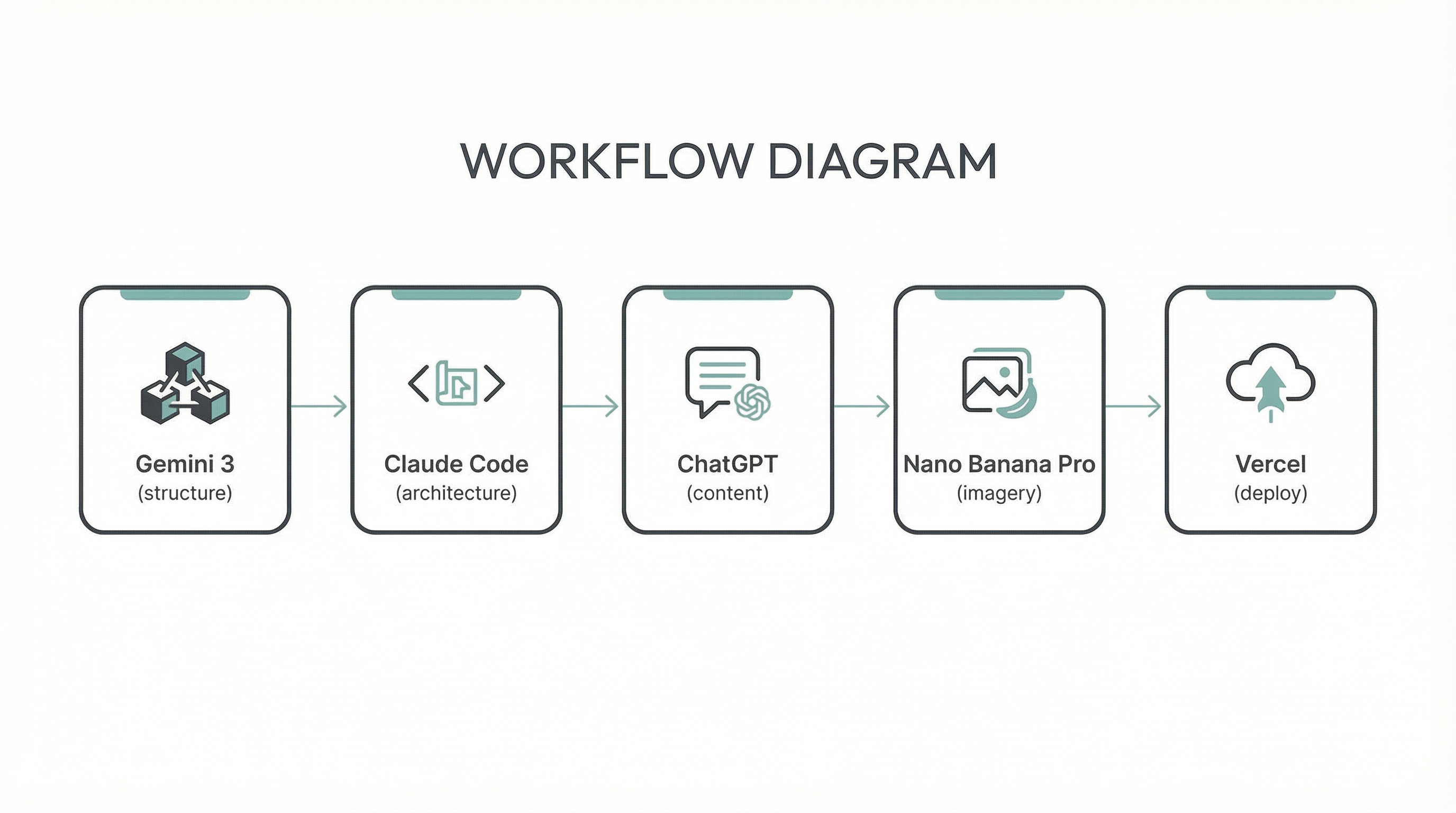
- Gemini 3 for broad structure and layout concepts
- Claude Code for architecture, refactoring, and framework-level changes
- ChatGPT for narrative, microcopy, and refinement
- Nano Banana Pro for imagery
- Vercel for deployment
Each model played to its strength. None of them could have done the job alone.
The real story isn't speed—though the speed is real. It's how AI shifts the texture of building. You can move fluidly between brainstorming, writing, refactoring, design, and deployment with barely any friction. Ideas stop dying in the space between "I want to try this" and "I need to block off three days to implement it."

What We're Actually Building Toward
Second Wave has always focused on practical intelligence—AI that helps people get work done, not AI that performs magic tricks. This website refresh was a small example of that philosophy in action.
It wasn't magic. It wasn't perfect. But it was fast, collaborative, and deeply hands-on. A small team of tools, each playing to its strength, orchestrated by human judgment.
That's the workflow we're designing for. That's what we mean by AI that actually ships.